Fulfillment Center, Unfulfilled Promise: How Amazon's Logistics Workers Are Turning the Supply Chain Into a Lever
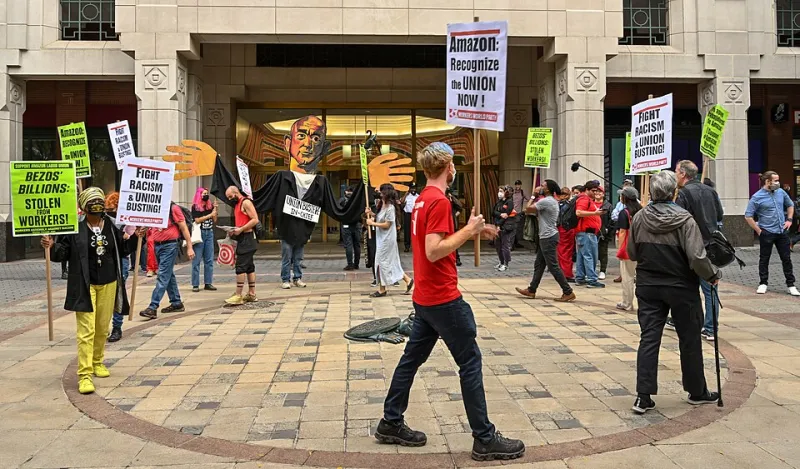
Photo: Joe Piette, CC BY-SA 2.0, via Wikimedia Commons
Amazon did not intend to build a monument to worker power. It intended to build a machine. Over the past two decades, the company assembled the most vertically integrated retail logistics operation in the history of American commerce—a continental web of fulfillment centers, sortation hubs, delivery stations, and last-mile vans that processes millions of consumer transactions every hour. The architecture was designed for speed, efficiency, and control. What Amazon's executives did not fully account for was the human variable embedded at every critical node of that machine.
That oversight is now being corrected—by the workers themselves.
The Chokepoint Economy
To understand why Amazon is unusually vulnerable to coordinated worker action, one must first understand what the company actually sells. Amazon's retail margins are notoriously thin; its competitive advantage rests almost entirely on logistics velocity. The promise of two-day, one-day, and same-day delivery is not merely a consumer convenience—it is the company's core value proposition to third-party sellers, Prime subscribers, and institutional clients alike. Any meaningful disruption to fulfillment throughput does not simply inconvenience customers. It strikes directly at the foundation of Amazon's market position.
This structural dependency creates what labor organizers have begun calling the chokepoint economy: a system in which a relatively small number of strategically positioned workers can exert disproportionate economic pressure by slowing, redirecting, or halting the flow of goods at critical junctures. The fulfillment center is not merely a warehouse. It is the beating heart of a revenue stream that generates hundreds of billions of dollars annually. A coordinated work slowdown at even a handful of high-volume facilities during peak shipping periods—the weeks surrounding Prime Day, Black Friday, or the holiday season—can produce financial consequences that dwarf the cost of any wage concession management might otherwise resist.
Tactics Emerging From the Floor
The tactics workers are developing do not always resemble the industrial actions of the twentieth century. Traditional strikes, while powerful, remain legally and financially precarious for workers without substantial union backing. What is emerging instead is a repertoire of more granular interventions rooted in workers' intimate knowledge of the operational systems they run every day.
Work-to-rule actions—in which employees perform their duties strictly according to posted safety protocols and official procedures, deliberately forgoing the informal shortcuts that keep productivity metrics artificially high—have proven particularly effective. Amazon's rate requirements, the productivity quotas that have drawn sustained criticism from labor advocates and federal regulators alike, are predicated on workers routinely exceeding what the official handbook permits. When workers withdraw that informal subsidy, throughput drops without any formal labor action having occurred.
At delivery stations and last-mile facilities, drivers have developed their own forms of collective leverage. Route coordination—informal networks through which drivers share information about unsafe conditions, unreasonable route assignments, or retaliatory management behavior—has evolved in some markets into something resembling a horizontal grievance structure. Workers who might be classified as independent contractors under Amazon's Delivery Service Partner model are discovering that solidarity does not require a union card.
The Amazon Labor Union and the Lessons of Staten Island
The April 2022 victory at the JFK8 fulfillment center on Staten Island, achieved by the independent Amazon Labor Union without affiliation to any established labor federation, demonstrated something that the broader labor movement is still absorbing: the traditional organizing model is not the only path to collective recognition. The ALU's approach—worker-led, community-embedded, and deliberately informal in its early stages—drew on the specific social geography of a working-class borough and the particular vulnerabilities of a workforce that had already endured the worst of the pandemic with inadequate protection.
The lessons being drawn from that campaign extend well beyond New York. Organizers at facilities in Illinois, Kentucky, Georgia, and the Pacific Northwest are studying the ALU's methods not as a template to be replicated wholesale, but as a demonstration that worker-controlled organizing structures can succeed against one of the most aggressive union-avoidance operations in corporate America. The key insight is not tactical but structural: workers who understand their own indispensability to the production process are workers who possess genuine power, regardless of whether that power has yet been formally recognized.
Replicability Across the Retail Logistics Sector
The model being developed in Amazon's facilities does not belong exclusively to Amazon. The same structural logic applies wherever a retailer has made a strategic commitment to logistics speed as a competitive differentiator. Walmart's regional distribution network, Target's urban fulfillment infrastructure, and the third-party logistics operations that service fast-fashion retailers all share the same fundamental vulnerability: they are only as reliable as the workers who operate them.
The distinction between Amazon and its competitors, at this moment, is largely one of organizing maturity. Amazon workers have had more time, more provocation, and more high-profile examples of collective action to draw upon. But the underlying conditions—productivity surveillance, algorithmic management, inadequate injury protections, and the constant threat of termination by automated systems—are neither unique to Amazon nor likely to improve without sustained worker pressure.
Syndicalist theory has long held that the most effective site of working-class power is the point of production itself. The warehouse floor, the delivery route, the sortation hub—these are not peripheral concerns. They are, in the language of industrial unionism, the commanding heights of the modern retail economy. Workers who understand this, and who act on that understanding with coordination and discipline, are not simply bargaining for better wages. They are demonstrating, in practice, the foundational claim of the labor movement: that the economy runs on their labor, not on the decisions of executives in Seattle or the algorithms of an automated management system.
What Comes Next
The immediate horizon for Amazon's logistics workforce involves a series of overlapping campaigns: continued ALU organizing efforts at additional facilities, legislative pressure around worker classification and surveillance practices, and the gradual construction of cross-facility solidarity networks that can coordinate action at scale. None of these efforts will produce transformation overnight. The company's resources for resistance remain enormous.
But the strategic situation has shifted. Amazon spent years cultivating the perception that its workforce was too dispersed, too surveilled, and too economically precarious to organize effectively. The workers at JFK8, and the thousands who have followed their example, have offered a direct rebuttal. The machine Amazon built to dominate American retail has a human core. And that core is beginning to understand its own power.